Biography
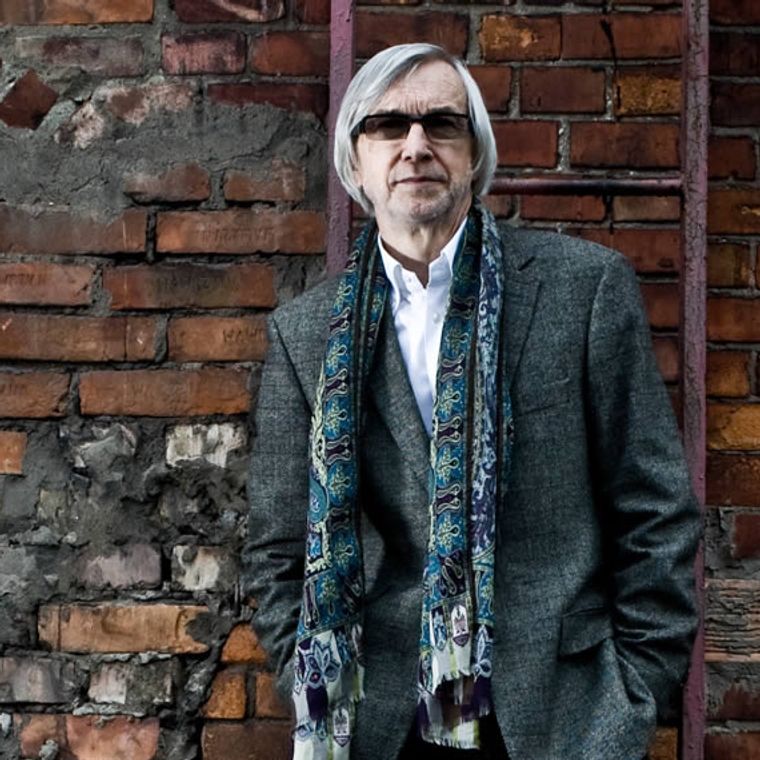
One of the most influential architects in Polish history, creator and co-author of numerous buildings awarded in prestigious Polish and international competitions. He was born on 26 March 1949 in Warsaw, into a family of architects — both his father, Witold, and his mother, Alina, were architects. Stefan Kuryłowicz followed in their footsteps and graduated from the Faculty of Architecture at the Warsaw University of Technology, with which he remained associated for many years, until his death in a plane crash in Spain in 2011. At that time he was a professor of the university and Head of the Department of Large-Scale and Industrial Construction.
In his teaching and design work he was guided by the conviction that the architect’s profession is one of public trust and therefore carries the obligation to confront one’s own work with public opinion. His ideas and the buildings realised from them, as well as his theoretical writing, changed the face of post-communist Warsaw and had a great influence on future generations of architects. The Kuryłowicz & Associates studio he created boldly combines creative architectural work with business and market requirements.
Stefan Kuryłowicz was a laureate of many national and international architectural and urban-planning competitions, working in teams — initially with the architects Andrzej Nasfeter and Tomasz Ciołek, and later within the teams of the Kuryłowicz & Associates studio he co-founded. He won his first competition, for the Baltic Opera, together with colleagues in 1974, two years after obtaining his master of engineering diploma. He received many awards, the most important being the SARP Honorary Award (2002) and his entry on the Golden List of graduates of the Warsaw University of Technology (2006). In 2010–2011 he was a member of the international team for the renovation and revitalisation of the UN headquarters complex in New York.
In private life he was the husband of the architect Ewa Kuryłowicz, with whom he collaborated, and the father of two sons, Michał and Marek; he was the twin brother of his sister Alina and the older brother of Justyna. He was also a sports enthusiast, a marathon runner, a sailor, a skier, an aeroplane pilot, a member of the Warsaw Aeroclub and a passionate traveller. He was a man full of warmth and kindness towards the people with whom and for whom he worked, and a recognised leader.
Timeline
Kuryłowicz was born 26 March 1949 in Warsaw, where both of his parents, Witold and Alina, were still students at the Architecture Faculty of Warsaw University of Technology.
Initially he had thought about studying at the University of Physical Education. He was convinced to change his plans by a letter from his father, who had emigrated. Kuryłowicz himself recalled the letter this way: “Over five pages, (my father) explained what people with architecture degrees do. The next five messages was about the misfortunes of young people who didn’t study architecture. The last half page was taken up by threats. He wrote that he would disinherit me – till today, I don’t know from what. So I studied architecture.” Following in the footsteps of this parents, in 1972 he was awarded a degree from the Architecture Faculty of Warsaw University of Technology. That same year he also began working there.
The beginning of the young architecture graduate’s career was related to theatre and opera buildings. The first design competitions he won with a team of friends included those of the Baltic Opera House in Gdańsk (1974), the Wrocław Philharmonic (1975), the Damascus Opera (2nd prize, 1979). This was also the subject of Kuryłowicz’s 1987 doctoral dissertation, titled “Wpływ uwarunkowań zewnętrznych na kształt przestrzenny zespołów teatralnych” (The influence of external conditions on the shape of theatre troupes’ spaces). But his first implemented project was a sausage stand in Warsaw’s Kępa Potocka neighbourhood.
From 1977 to 1999, Kuryłowicz worked in the Industrial and Large-Space Architecture Design Studio in the Architecture Faculty of Warsaw University of Technology, and in 1999 he became its director. This studio was shaped by its founder, Professor Jerzy Hryniewiecki, and continued by Prof. Maciej Gintowt. While Kuryłowicz decided to found his own professional practice, he never left his work at his alma mater, and took an enthusiastic approach to the education of young architects. He supervised more than 100 diploma projects, of which many won awards in domestic and international competitions, and in 2009 he had the honour of being recorded in the Golden Book of Warsaw University of Technology Graduates.
In 1983, Kuryłowicz founded the Kuryłowicz Architecture Studio (APA Kuryłowicz), operating as part of the Architecture Studios State Enterprise), and seven years later in 1990 he changed it into the Kuryłowicz & Associates Architecture Studio. As the chief designer and president of this studio, he was the co-creator of many prestigious buildings that won awards in domestic and foreign competitions. The most significant of these are the VitkAc shopping centre in Warsaw; the Warsaw office buildings Prosta Tower, Focus Filtrowa, Wolf Nullo and Królewska; the headquarters of LOT Polish Airlines, Fuji Film Poland, Emi Pomaton, Avon and Reprograf; the industrial buildings Avon Cosmetics in Garwolin, Arcon ISC in Warsaw and Ostervijg in Nieporęt. He was also the designer of buildings and residential developments including Eko Park and Marina Mokotów in Warsaw; hotels including the Gdańsk Hilton, the Hilton Doubletree in Łódź, Courtyard by Marriott at Chopin airport in Warsaw and churches in Nowy Dwór Mazowiecki, the Widzew housing estate in Łódź, Grodzisk Mazowiecki and the Wierzbno estate in Warsaw. Among these buildings the office projects alone won numerous awards and distinctions, while the A-4 complex from the Eko Park estate won an award during the annual exhibition of the Architects’ Council of Europe as the only Polish project presented in the European Parliament in Brussels in 2010. The presentations of buildings and projects that arose under Kuryłowicz’s direction were discussed in Polish and foreign books, including The Phaidon Atlas of Contemporary World Architecture (Phaidon Press, London, New York 2003), Materials for Architectural Design (Laurence King Publishing, London 2006), and numerous periodicals, including Architectural Review, World Architecture, Architektura-murator and Architektura & Business. Kuryłowicz & Associates also carried out projects that resulted both from victories in competitions (the National Forum of Music in Wrocław in 2005, the Language Departments Building for the University of Warsaw in 2006, the Ochota Campus for the University of Warsaw in 2007 and the Supersam office-commercial complex in Warsaw in 2007), and in long-term relationships with private investors (Wolf Immobilien Polen, Echo Investment, GTC, Qualia Investments, Eko Park and others).
Kuryłowicz was awarded the academic title of habilitation on the basis of his work “Architektura – idea i jej realizacja 1998–1999” (Architecture: the idea and its execution, 1998-1999, Wydawnictwo Politechniki Krakowskiej, Kraków 2000). In 2002–2006 Kuryłowicz was the first professional responsibility ombudsman of the National Chamber of Polish Architects. Additionally, beginning in 1974 he also played an active role in the SARP Association of Polish Architects, where he served for many years as a vice president and competition judge. As part of SARP, he also worked with the UIA International Union of Architects.
Kuryłowicz won an Award of Honour from the Association of Polish Architects.
Kuryłowicz was awarded by the Ministry of Culture and National Heritage for outstanding achievements.
In 2010 he was invited to join the five-member UN Secretary General’s Advisory Committee for Reconstruction of the UN Headquarters in New York. He participated in the committee’s work through June 2011.
On 6 June 2011 Stefan Kuryłowicz died in a plane crash in Asturias, Spain. He was buried in the Avenue of Honour, so-called Professors’ Avenue, in Powązki Military Cemetery in Warsaw.
Photo archive
 Stefan Kuryłowicz przy desce kreślarskiej
 Zespół projektantów Opery Gdańskiej — Stefan Kuryłowicz (pierwszy z prawej)
 Stefan i Ewa Kuryłowiczowie
 Stefan i Ewa Kuryłowiczowie
 Stefan Kuryłowicz
 Stefan Kuryłowicz
 “A Carpet of Memories”, Z. Judejko and A. Kuryłowicz
 With his sisters in Vancouver
 The Grand Canyon
 With a project model
 Paris, Giverny
 Ewa and Stefan Kuryłowicz